


You’re busy. You know you should exercise more. You’ve probably told yourself “I’ll start this week” more times than you want to count.
- Why Skipping Rope Makes Sense for Busy People
- 10 Skipping Rope Benefits (With How-To and Progressions)
- Benefit 1: Burns Calories Faster Than Most Cardio Options
- Benefit 2: 10 Minutes Can Match Much Longer Cardio Sessions
- Benefit 3: Strengthens Your Heart and Lungs
- Benefit 4: Builds Coordination, Balance, and Agility
- Benefit 5: Develops Lower Body and Core Strength
- Benefit 6: Supports Bone Health and Joint Resilience
- Benefit 7: Portable, Affordable, and Always Available
- Benefit 8: Scales for Every Fitness Level
- Benefit 9: Sharpens Mental Focus and Lifts Mood
- Benefit 10: Keeps You Coming Back Because It’s Genuinely Enjoyable
- How to Choose and Set Up Your Rope
- 4-Week Beginner’s Jump Rope Plan
- Week 1: Foundations
- Week 2: Intervals and Coordination
- Week 3: Progress and Variety
- Week 4: Skill and Endurance
- Safety, Common Mistakes, and Injury Prevention
- FAQs
- Key Takeaways and Next Steps
Here’s the real friction: most fitness advice assumes you have time, space, and money you don’t have. A gym membership. A commute. Equipment that won’t fit in your flat. That’s a lot standing between you and actual results.
Skipping rope removes almost all of it. A decent rope costs under £15. It weighs less than a book. You need roughly two square metres of space. And 10 minutes of structured jump rope work delivers cardiovascular benefits comparable to much longer steady-state sessions — research published in the Research Quarterly for Exercise and Sport confirms that. If you’re a busy professional, coach, consultant, or creator trying to protect your energy and stay mentally sharp, the case for picking up a rope is stronger than you think.
This guide covers 10 proven skipping rope benefits, the evidence behind each one, gear advice that won’t waste your money, and a practical 4-week beginner’s plan you can start today.
Disclosure: Our content is engineered to help you make informed, data-driven, and smart decisions. DecsEdge is reader-supported; when you engage with our recommendations or click certain links, we may receive a commission. This support allows us to continue delivering the digital solutions you rely on. Thank you for being part of our community.
Why Skipping Rope Makes Sense for Busy People
Most people associate skipping rope with boxing gyms and school playgrounds. That’s a limited picture. Competitive athletes across boxing, basketball, tennis, and football use it as a primary conditioning tool — not because it’s nostalgic, but because it delivers a high volume of cardiovascular and neuromuscular work in a short window.
For someone managing a business, serving clients, raising a family, or building a creative output, fitness often loses in the prioritisation battle. Not because it doesn’t matter, but because most exercise options require more setup than the time permits. Skipping rope changes that calculation entirely.
You don’t need a change of scenery. You don’t need equipment bolted to a wall. You can jump in your living room, your hotel room, your backyard, or your office car park. That flexibility is not a minor point. Consistency is the single biggest driver of fitness results, and consistency depends on how easy it is to show up.
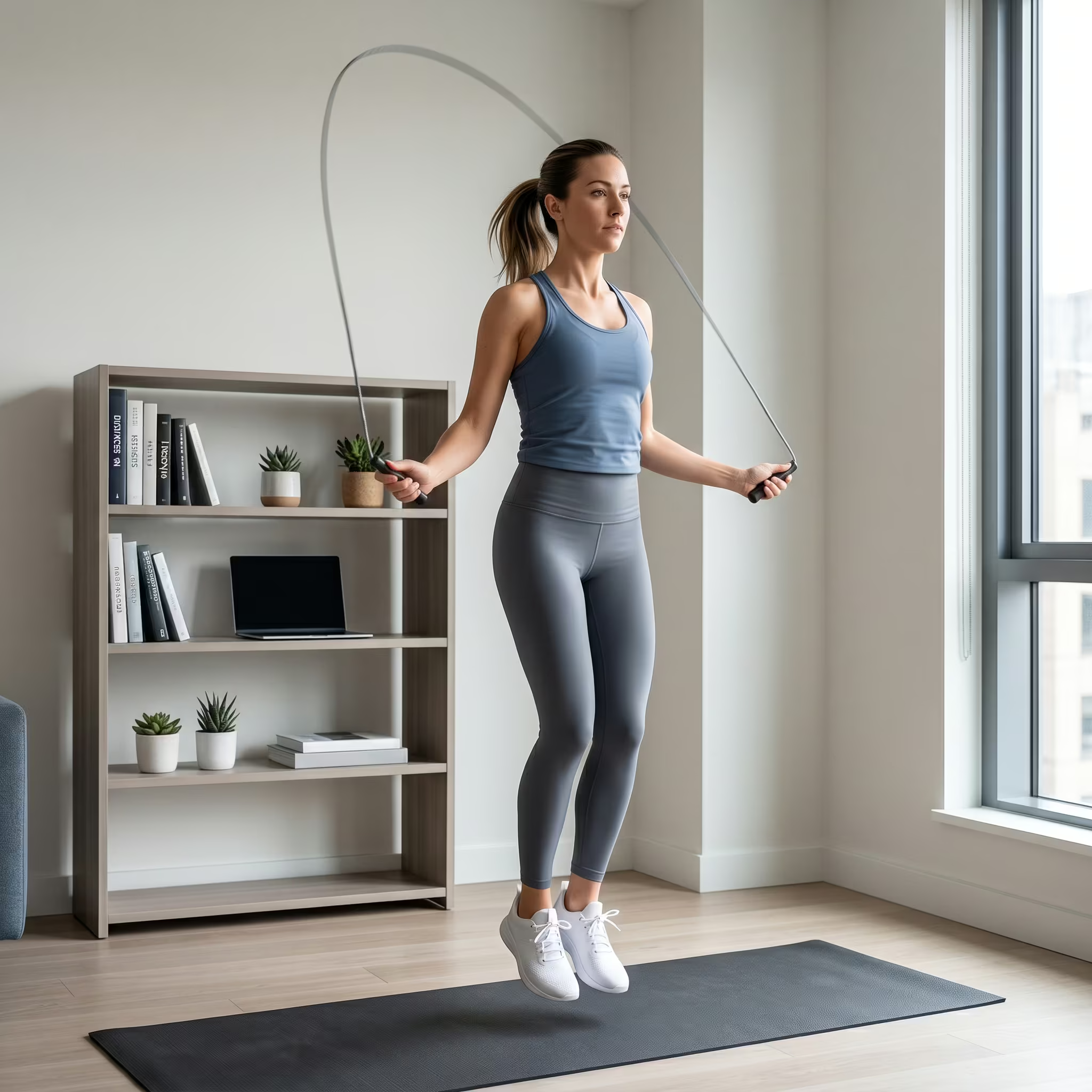
[IMAGE PLACEHOLDER: Professional jumping rope in a compact indoor space | Alt text: “skipping rope benefits for busy professionals”]
10 Skipping Rope Benefits (With How-To and Progressions)
Benefit 1: Burns Calories Faster Than Most Cardio Options
Skipping rope is one of the most calorie-dense cardio activities per minute available to the average person. A 70 kg adult jumping at moderate to vigorous intensity burns roughly 700 to 1,000 calories per hour, according to estimates from Healthline. That puts it alongside running at a solid pace, with none of the distance, the commute, or the need to leave your building.
Why? Your calves, quads, glutes, shoulders, arms, and core all fire at the same time. More muscles working simultaneously means more energy demanded per minute. Compare that to a stationary bike where your upper body contributes almost nothing, and the efficiency gap becomes obvious.
How to use this benefit: Start with 1 to 2 minute intervals at a pace where short sentences are possible but uncomfortable. Rest for 60 seconds, then repeat. Build the ratio from 1:1 work-to-rest toward 2:1 as fitness improves.
Progression: Once standard singles feel manageable, introduce high knees or faster cadences to lift the caloric demand without extending the session.
[IMAGE PLACEHOLDER: Calorie comparison chart for jump rope, running, and cycling | Alt text: “skipping rope benefits calorie burn per minute”]
Benefit 2: 10 Minutes Can Match Much Longer Cardio Sessions
This is the skipping rope benefit most people never hear about, and the one most relevant to anyone whose diary is already full.
A landmark study published in the Research Quarterly for Exercise and Sport found that six weeks of daily 10-minute skipping rope sessions improved cardiovascular fitness to a comparable level as 30 minutes of daily jogging when total exertion was matched. That’s a 3:1 time efficiency ratio. More recent PubMed-indexed HIIT research reinforces the same finding: short, high-intensity bouts produce adaptations equal to or exceeding longer moderate-intensity sessions.
For a professional who can find 10 minutes three times a week but not 30, that distinction changes everything.
How to use this benefit: Replace one 30-minute low-intensity cardio session per week with a structured 10-minute jump rope HIIT session. Assess your stamina and energy over four weeks.
[INTERNAL LINK: DecsEdge guide on time-efficient productivity strategies for professionals]
Benefit 3: Strengthens Your Heart and Lungs
Cardiovascular fitness — how efficiently your heart and lungs deliver oxygen to working muscles — is one of the strongest single predictors of long-term health. The American Heart Association counts rope skipping among vigorous aerobic activities that meet the recommended 75 minutes per week of vigorous exercise. (heart.org)
Regular jump rope work improves VO2 max over time and lowers resting heart rate. It builds the aerobic base that underpins every other physical and cognitive demand in your working day. The link between cardiovascular fitness and sharper thinking, better stress regulation, and sustained energy output is documented in the research. It’s not a motivational talking point.
How to use this benefit: Aim for three to four sessions per week. Even 10 to 15 minute sessions count toward your vigorous activity target. Track resting heart rate monthly as a simple, free marker of cardiovascular progress.
Benefit 4: Builds Coordination, Balance, and Agility
Most adults stop training coordination around the time they stop playing competitive sport. That creates a slow, often unnoticed decline in neuromuscular efficiency, which shows up as poor posture, balance problems with age, and clumsy movement patterns under pressure.
Skipping rope demands precise timing between hand rotation and foot clearance. The rope gives immediate, honest feedback: get the timing wrong and you know straight away. Over weeks of practice, this trains the accuracy and speed with which your nervous system communicates with your muscles. The Cleveland Clinic highlights coordination and agility as primary outcomes of consistent rope work. (clevelandclinic.org)
Athletes use jump rope for reaction time and footwork. For everyone else, it reduces fall risk, improves balance, and creates cleaner movement patterns in sport and daily life.
How to use this benefit: Add rhythm drills: 30 seconds of alternating single-leg hops (15 seconds per leg), followed by 30 seconds of two-foot steady jumps. Repeat three times. This targets neuromuscular balance specifically, rather than just endurance.
[VIDEO PLACEHOLDER: Beginner coordination drill — alternating foot hops and single-leg balance | Alt text: “skipping rope coordination drills for beginners”]
Benefit 5: Develops Lower Body and Core Strength
Skipping rope is not purely a cardio tool. Each jump recruits the calves, quads, hamstrings, glutes, and the full core musculature. A study in the Journal of Sports Science and Medicine, indexed on PMC, found measurable improvements in lower body muscular endurance among participants following a structured 8-week jump rope programme.
The gains are functional. This is strength built through repeated, rhythmic, full-range movement — the kind that translates to better posture, more stable knees, and reduced lower back pain. For desk workers, that last one is worth taking seriously.
To be accurate: skipping rope will not replace resistance training if building mass is your goal. What it delivers is lean muscular endurance and joint stability, which support every other form of training you might do alongside it.
How to use this benefit: Combine jump intervals with bodyweight strength work. After each 2-minute rope interval, add 10 squats or a 30-second plank. You now have a full conditioning session in under 20 minutes.
[INTERNAL LINK: DecsEdge guide to bodyweight training for busy professionals]
Benefit 6: Supports Bone Health and Joint Resilience
Impact exercise, progressed sensibly and performed on forgiving surfaces, stimulates bone density improvements. This matters for adults from their 30s onward, when bone mass begins a gradual decline without consistent loading. The Cleveland Clinic notes that skipping rope, approached thoughtfully, can help maintain bone density in the hips, spine, and feet. (clevelandclinic.org)
The critical word is progressively. Going from no exercise to 1,000 jumps per day on a concrete floor will injure you. Building from 5 minutes on a sprung surface or exercise mat, increasing volume by 10 to 20 per cent per week, delivers the adaptive stimulus without the breakdown.
People with diagnosed osteoporosis or significant joint disease should consult a clinician first. For most healthy adults, jump rope is among the safer impact activities available when introduced correctly.
How to use this benefit: Jump on wooden floors, sprung floors, or a 10mm exercise mat. Avoid concrete. Wear supportive cross-training shoes with cushioning at the ball of the foot, not flat-soled trainers.
Benefit 7: Portable, Affordable, and Always Available
The most effective fitness programme is the one you actually complete.
A quality jump rope costs between £8 and £25. It weighs under 200 grams. It fits in the front pocket of a rucksack. You need a ceiling height of at least 2.5 metres and roughly 1.5 square metres of floor space. That covers most hotel rooms, spare bedrooms, garages, and car parks.
This means your workout travels with you. Long-haul flight before a client presentation? Hotel room session before breakfast, done. Working from home between back-to-back calls? Five minutes before lunch. Conference week with no time for the gym? Ten minutes at 7am in the hotel corridor.
The professionals who stay consistently fit tend to do it by removing barriers, not by finding extra willpower. Skipping rope is one of the most effective barrier-removal tools in fitness.
How to use this benefit: Pack a rope with your laptop every time you travel. Schedule three sessions per week in your calendar and treat them like meetings.
[IMAGE PLACEHOLDER: Jump rope packed alongside a laptop in a travel bag | Alt text: “portable skipping rope benefits for travelling professionals”]
[INTERNAL LINK: https://decsedge.com/digital-tools-for-entrepreneurs]
Benefit 8: Scales for Every Fitness Level
One of skipping rope’s genuine strengths is that the same tool works whether you’re a complete beginner or an experienced athlete. The variable is not the equipment. It’s the intensity, the duration, the skill complexity, and the rest-to-work ratio.
Beginners start with slow, controlled two-foot jumps and rest periods equal to work periods. As fitness builds, rest shortens, speed increases, and skills like the criss-cross or double-under get layered in. Regressions also exist: stepping over a rope laid on the ground replicates the rhythm and coordination work without any joint loading at all.
Healthline’s jump rope benefit guide covers progressions across experience levels in useful detail.
How to use this benefit: Use the Rate of Perceived Exertion scale from 1 to 10. Target RPE 5 to 6 as a beginner. Rising to 7 to 8 as your fitness grows. Adjust interval length and rest time, rather than trying to jump faster before your technique supports it.
Benefit 9: Sharpens Mental Focus and Lifts Mood
Exercise and cognitive performance are connected in ways that go well past “feeling good after a run.” Aerobic exercise stimulates the release of brain-derived neurotrophic factor (BDNF), a protein linked to neuron growth, improved memory, attention, and learning capacity. Research indexed on PMC found that short bouts of coordinated aerobic exercise improved working memory and attention in both children and adults.
Skipping rope adds a coordination layer that most cardio lacks. You’re managing rhythm, timing, and movement simultaneously, and that cognitive demand matters. It appears to amplify the mental benefit compared to passive cardio like walking on a treadmill while staring at a news feed. Your brain is actually doing something the whole time. That’s not a minor difference.
From a practical standpoint: a 10-minute skipping session before a demanding call, a presentation, or a writing block can shift your mental state measurably. Test it before your highest-focus task of the day instead of relying on caffeine alone.
How to use this benefit: Jump for 10 minutes before your most cognitively demanding work block. Add intentional breathing: four counts in through the nose, four counts out through the mouth at a steady jump pace.
[INTERNAL LINK: https://decsedge.com/digital-focus-tools-for-productivity]
Benefit 10: Keeps You Coming Back Because It’s Genuinely Enjoyable
Consistency beats intensity, every time. A session you look forward to three times a week outperforms the “perfect” workout you do once a fortnight.
Skipping rope has a skill ceiling most other cardio tools don’t. Speed work, freestyle tricks, interval challenges, partner drills, double-under progressions — there’s always a new target to aim for. That sense of developing a skill, rather than just surviving a session, keeps people engaged in a way that the treadmill simply doesn’t.
Enjoyment is a documented driver of exercise adherence. Medical News Today notes it as a significant predictor of sustained physical activity habits. This is not a soft benefit. It’s the variable that determines whether everything else on this list actually happens.
How to use this benefit: Build a 10-day micro-challenge. Five minutes of steady jumps per day for 10 days. The improvement in rhythm and stamina you’ll notice between day one and day ten is usually enough to make you want to continue.
How to Choose and Set Up Your Rope
The rope matters more than most beginner guides acknowledge. Using the wrong type adds friction to the learning process before you’ve built any rhythm.
Rope types by use:
- PVC speed ropes (£8 to £15): Fast, light, and standard for fitness and HIIT. The default choice for most people once they have basic technique.
- Beaded ropes (£10 to £20): Heavier and audible. The rhythmic click helps beginners learn timing. Highly recommended for new starters.
- Weighted ropes (£15 to £40): Heavier handles or cables add resistance. Useful for conditioning work, but not the right choice while learning.
- Leather ropes: Durable, fast, and used professionally in boxing. Not necessary for general fitness.
Sizing your rope: Stand on the centre of the rope. Pull both handles upward; they should reach your armpits. If they hit your shoulders or chest, the rope is too long. Most adjustable ropes make this straightforward.
Surface and footwear: Wooden floors, sprung gym floors, or a 10mm foam exercise mat work well. Avoid concrete and hard tiles without matting. Cross-training shoes with forefoot cushioning are the right footwear; running shoes with a raised heel are not ideal for rope work.
Technique cues to build from day one:
- Keep elbows close to your sides. The rope turns from the wrists, not the shoulders.
- Jump just high enough for the rope to clear (1 to 3 inches).
- Land on the balls of your feet with a slight bend in the knees.
- Keep your posture tall and your eyes forward.
[IMAGE PLACEHOLDER: Rope sizing demonstration — handle height reaching armpit | Alt text: “how to size a skipping rope for beginners”]
4-Week Beginner’s Jump Rope Plan
This plan builds skill, conditioning, and the habit simultaneously. Sessions run 10 to 20 minutes including warm-up and cool-down. Frequency is three to four sessions per week.
Before every session: 5 minutes of dynamic warm-up: march in place, hip circles, ankle rotations, and light arm swings. This is not optional when you’re new to impact work.
Week 1: Foundations
Goal: Learn the basic rhythm. Build tolerance for impact.
- 5 rounds: 60 seconds jumping at a controlled pace / 60 seconds rest
- Focus entirely on technique: elbows in, wrist rotation, soft landing on the balls of your feet
- Finish with 5 minutes of calf and hamstring stretching
Week 2: Intervals and Coordination
Goal: Introduce intensity variation and single-leg work.
- 6 rounds: 30 seconds fast / 30 seconds rest
- 2 rounds: 60 seconds at a steady pace
- Add 2 sets of 15 seconds single-leg hopping per leg at the end
- Total target: 15 to 20 minutes including warm-up
Week 3: Progress and Variety
Goal: Build endurance and introduce bodyweight conditioning.
- HIIT block: 10 rounds of 20 seconds jumping / 40 seconds rest
- Mix in high knees, lateral steps, and side swings across rounds
- Add between rounds: 3 sets of 30-second plank plus 10 squats
- Total target: 20 minutes
Week 4: Skill and Endurance
Goal: Introduce a new skill. Build mental toughness through a pyramid structure.
- Pyramid: 30 seconds / 45 seconds / 60 seconds / 45 seconds / 30 seconds (rest equals half work time)
- Attempt criss-cross or double-under progression for 5 minutes at the session end
- Total target: 20 to 25 minutes
Progress is the aim. If a week feels too aggressive, repeat it rather than pushing into injury. One step back now saves three weeks of forced rest later.
Safety, Common Mistakes, and Injury Prevention
Most skipping rope injuries are preventable. They come from one of three sources: the wrong surface, poor technique, or too much too soon.
Common mistakes to address early:
- Jumping too high. You only need to clear the rope, not the ceiling. Excess height wastes energy and loads the calves unnecessarily.
- Turning from the shoulders. The rope rotates from the wrists. Shoulder rotation slows the rope and creates fatigue far faster.
- Skipping on hard floors without appropriate footwear. Concrete with flat-soled shoes is the fastest route to shin splints.
- Rushing the progression. Two minutes of skipping feels easy in week one. Adding ten minutes the following week is not a sensible jump.
Safety rules worth keeping:
- Increase total jump time by 10 to 20 per cent per week.
- Prioritise form over speed, at every stage.
- If you feel sharp pain in the knee, shin, or Achilles tendon, stop and rest for 48 hours. Persistent pain needs a physiotherapist, not more jumping.
- Anyone with cardiovascular conditions, significant joint damage, or bone health concerns should consult their GP before starting any new impact exercise.
FAQs
What are the main skipping rope benefits for beginners? The most accessible benefits for new starters are time-efficient calorie burn, improved cardiovascular fitness, better coordination, and the freedom to train anywhere. Within two to three weeks of consistent practice, most beginners notice measurable improvements in stamina and rhythmic timing.
How many calories does skipping rope burn? A 70 kg adult burns roughly 700 to 1,000 calories per hour at moderate to vigorous intensity. At an easy beginner pace, expect closer to 400 to 500 calories per hour. The wide range reflects weight, intensity, and skill level. A chest-worn heart rate monitor gives you the most accurate personal estimate.
Is skipping rope safe for people with bad knees? It depends on the condition. Jump rope involves impact, and anyone with known joint damage, arthritis, or a surgical history should consult a physiotherapist before starting. Regressions such as step-overs (no jumping) or stepping in place without a rope can deliver much of the coordination and rhythm benefit without the loading.
How often should a beginner jump rope? Three sessions per week is the right starting frequency. Each session should include warm-up and cool-down, with total active jumping kept under 15 minutes for the first two weeks. Adding a fourth session in weeks three and four is a sensible progression.
Can skipping rope help with weight loss? Yes, as part of a calorie-controlled diet. Skipping rope creates energy expenditure that contributes to the deficit needed for fat loss. It won’t compensate for a poor diet on its own. Pair consistent rope sessions with tracking your food intake and the combination works faster than either approach alone. Medical News Today has useful context on jump rope and weight management.
How quickly will I see results from skipping rope? Cardiovascular improvements typically arrive within two to four weeks of three sessions per week. Visible body composition changes take longer and depend heavily on nutrition. Coordination and technique improvements are the fastest-arriving benefit — many people notice real gains within the first week of consistent practice.
What is the best surface for jumping rope? A sprung wooden floor, rubber gym matting, or a 10mm foam exercise mat. These absorb shock and reduce joint stress. Concrete, tiles, and hard marble are the worst choices, especially without proper footwear.
Is jump rope better than running? Neither is universally better. Jump rope offers comparable cardiovascular returns in less time, travels with you, and places less cumulative stress on the joints for most people. Running offers distance-based goals and outdoor benefit. For time-pressed professionals, jump rope wins on practicality. For those who find long outdoor runs genuinely restorative, that counts too. The honest answer: choose the one you’ll actually do consistently.
Can I lose belly fat by jumping rope? You can’t target fat loss to a specific body area — that’s not how fat metabolism works. What skipping rope does is burn calories efficiently. A sustained calorie deficit leads to fat loss across the body, including the midsection. Combined with core-strengthening exercises and sensible nutrition, consistent rope sessions contribute to a leaner core over time.
Key Takeaways and Next Steps
Skipping rope works. It burns calories efficiently, builds cardiovascular fitness, improves coordination, strengthens the lower body and core, supports bone health, sharpens mental focus, and fits into schedules that can’t accommodate conventional gym sessions. The research backs every claim. The practicality is self-evident.
The best move right now is to start small and build a streak. Buy a beaded or PVC rope for under £15. Run Week 1 of the plan above for three sessions before you evaluate anything. Most people who try it consistently for two weeks keep going — because within that window, they can feel the difference.
If you want to go further and integrate smarter tools and systems into how you work and train, explore our guide to digital tools for entrepreneurs or our resource on digital focus tools for productivity.
Ready to make sharper, more strategic decisions across your work and life? Book a Transformation Clarity Call with a DecsEdge consultant. Let’s look at the whole system together.
